
Johnston County Busted Mugshots
A mugshot is taken when someone is booked into jail. Johnston County's arrest records work like this: the Sheriff's Office runs the county Detention Center and posts the main tools for finding current inmates and recent arrests. Town police in Clayton, Smithfield, and Selma can start their own arrest paperwork first. Then the county jail opens a booking record once the person actually enters county custody.
Each step leaves its own paper trail. Arrest, booking, photo, roster entry, court case, and final outcome may sit with different record holders. So the right search depends on your question. Looking for a current inmate? That's one tool. Older documents and court results live elsewhere.
Johnston County busted mugshots appear here as booking entries pulled from local arrest activity. Each entry ties a name to a date and a charge at the time of booking.
What Johnston Busted Records Show
The Johnston County Sheriff's Office offers two public views. One is the current inmate inquiry, a snapshot of who is in custody right now. The other is a recent-arrest index covering the past 15 days, whether the person is still held or already out. Neither one gives a full lifetime arrest history. If a field is blank on one page, treat it as not shown there rather than missing from the underlying file.
| Public field | What it can tell you |
|---|---|
| Name | The name displayed by the roster or arrest result. Check spelling and identity details carefully. |
| Age, race, and sex | Basic demographic fields shown on public detail views. |
| Booking or arrest date | When the person entered the booking or recent-arrest record. These are not court dates. |
| Charge | The alleged offense recorded at intake. It is not a finding of guilt. |
| Bond amount and type | Shown on the observed recent-arrest detail. The current roster did not consistently expose a full bond set. |
| Booking agency | The agency value tied to the arrest. The observed display may use an internal number, so do not guess at its meaning. |
| Inmate photo | A photo may appear on a current-inmate detail or recent-arrest detail when available. |
| Primary charge and sort controls | The roster list shows a primary charge and can sort by name, arrest date, or charge description. |
Some details rarely show up in these views. Booking numbers are one gap. Court dates, projected release dates, and release reasons are others. Arresting officer names often stay unpublished too. Ask the record custodian for those, or check the court file. One more wrinkle exists. The JCSO arrest detail notes that an outside agency may control an image. A blank photo is a routing issue, not proof none was taken.
Request a Johnston Booking Photo
JCSO posts no online booking-photo request form. There is no fixed photo fee either. Its contact page routes incident and arrest reports to 919-989-5010, and the administrative office sits at 2875 US HWY 70 BUS E, Smithfield, NC 27577. Keep your request narrow. Name a specific booking record, arrest detail, or photograph, and give the likely date and agency. A targeted ask is far easier to process than a demand for everything on file about a person.
- Write the full name, approximate arrest or booking date, and arresting agency if known. Add a date of birth only when lawfully needed to distinguish people.
- State the exact record sought: public booking fields, booking photograph, arrest detail, or all existing public portions.
- Ask for electronic inspection or delivery, and ask whether JCSO or an outside agency holds the image.
- Use the county public-records form as a reference for requestor details and preferred delivery. It shows no charge for email delivery or scheduled inspection and $0.30 per paper copy, but confirm that amount with JCSO because it is not a dedicated jail-photo tariff.
- Ask the records unit for the actual response estimate. The research found no guaranteed JCSO turnaround.
State public-records guidance allows requests in any format, with no single statewide form required. An agency does not have to create a new record or rebuild data just for you. G.S. 132-1 is the broad starting point. G.S. 132-1.4 covers criminal-investigation records and their limits. If something gets withheld, ask for the statutory reason and request the segregable public portions.
Retention and online visibility are two different things. The roster shows current custody only. The arrest search stops at 15 days. Under the State Archives sheriff schedule, ID photos not tied to a case file may be destroyed after three years in the office, subject to holds. Photos in a case file follow the case-history schedule instead. That does not mean day 16 deletes an arrest record, or that every photo vanishes after three years.
North Carolina Mugshot Law
North Carolina has no general pay-to-remove law on the books. The main photo and fingerprint authority is G.S. 15A-502, which governs photographs and fingerprints in specified arrest, charge, imprisonment, and conviction settings, with a juvenile-delinquency limit. It does not force agencies to post images online. A 2025 House proposal on publication restrictions died in the legislature and is not current law.
Law in plain terms: G.S. 132-1 and G.S. 132-1.4 open the door to many public records and arrest details, but juvenile, sealed, expunged, confidential, investigative, and outside-agency material can narrow what is actually available.
If a case ended in your favor, start with the North Carolina expunction statute. Eligibility turns on the charge, the disposition, timing, prior record, and which statutory route fits. G.S. 153, formally G.S. 15A-153, explains what an expunction does. A court order can direct custodians to purge covered entries, but it will not automatically wipe a copied news or aggregator page.
JCSO has no standalone photo takedown policy. Send a precise correction request to the custodian with the official URL, the name, the arrest date, and any supporting order. Some publishers run free removal routes. Busted Newspaper publishes a free removal process, Recently Booked has a no-fee qualifying correction policy, and Mugshots.com offers a free record-maintenance path. Mugshots.zone lists a county removal URL, and Arrests.org lacks a clear county-specific free procedure. These are voluntary publisher processes, not legal rulings.
Skip any paid service promising to suppress an arrest image. Use the court process, the official correction route, and a publisher's documented free process. Once a source actually changes, use the search engine's outdated-content tool. Search engines cannot erase the sheriff, court, or news source itself.
Find Recent Johnston Arrests
Start any Johnston County arrest search with the sheriff's office itself. The JCSO maintains two separate tools. Picking the right one saves time. Want to know whether someone sits in the county jail right now? Check the current roster. If the booking just happened and the person may already be out, pull up the arrest form instead. The systems overlap, since a fresh booking tends to show in the arrest feed before the roster catches it. The reverse is true too. Once released, the roster drops a person, while the recent-arrest record can linger in view for a while.
- Open the JCSO inmate-search page for current county custody and follow its official portal link.
- For a recent event, use the JCSO arrest-search page and the linked form. Search by required last name, optional first name, or a date range within the last 15 days.
- Open the detail and note the charge, arrest date, bond fields, booking agency, image status, and data-updated time.
- Check NC eCourts or the Johnston County Clerk for the case events and disposition.
- If the person is in state prison, probation, or parole, use the NC DAC offender search. If the record is federal or immigration-related, use BOP or ICE instead.
- If no online result fits, request the existing record from JCSO or the arresting municipal agency.
That sequence works well for a few common situations. You might be reconnecting with someone, waiting on a release, tracking a court case, or filing a lawful records request. Even so, expect gaps. Arrests handled by outside agencies, lagging data, restricted records, or a photo held elsewhere can all keep a booking from showing up online at all.
Where Johnston Busted Mugshots Appear
Go to official sources first. The table on this page splits things into current custody, recent arrest data, state custody, and secondary discovery pages. Local news will sometimes run a booking photo alongside a story. That is reporting, though, not a full jail roster. Third-party sites can keep old copied entries alive long after the fact. Their dates and details often go stale. Treat any republished image as a copy of something that may have changed since it was captured.
| Channel | Photo? | Official? | How to use it |
|---|---|---|---|
| JCSO inmate inquiry | On detail when available | Yes | Current Johnston County custody; check its updated notice. |
| JCSO recent-arrest form | On detail when available | Yes | Recent arrests within a rolling 15-day window. |
| NC DAC | No county-style photo promise | Yes | State prison, probation, and parole records, not county jail. |
| eCourts and Clerk | Not a mugshot source | Yes | Case events and disposition after booking. |
| JCSO records request | Ask for existing image | Yes | Older, missing, or outside-agency records. |
| JoCo Report | Story by story | No | Local crime coverage, not a complete booking list. |
| Busted Newspaper and Recently Booked | Often | No | Unofficial copies; compare every entry with JCSO. |
| Mugshots.com, Arrests.org, and Mugshots.zone | Often | No | Unofficial archives with uneven coverage and timing. |
A couple of caveats on where busted mugshots do not appear. The county's official Facebook feed works as an occasional alert and news channel. It is not a photo roster. JCSO has no dedicated jail app. The detention page's current PayTel notice deals with inmate phone service, and the older Securus references are simply historical service info.
Busted on the Johnston Jail Roster
The Johnston County Inmate Inquiry is embedded in the JCSO detention-center page. It remains the best official starting point for current custody. Think of it as a live list, not a permanent arrest archive. Names move through it constantly as people are booked, released, transferred, or shifted into another custody system. An entry that vanishes simply reflects that movement.
| Roster control or field | What to do |
|---|---|
| Name search | Use the available name controls, then open the matching detail. |
| Sort by name | Useful when the spelling is known but the list is long. |
| Sort by arrest date | Helps place an older arrest within current custody. |
| Sort by charge description | Groups the displayed primary charge, without changing its legal status. |
| Data Last Updated | Record the timestamp. JCSO describes the account as live but gives no fixed hourly refresh promise. |
| Name detail | May show age, race, sex, booking date, charge information, and a photo when available. |
Checking the roster takes a few steps. Open the official landing page, submit your search, and compare the name and charge. Then open the detail view and read the update notice. When a photo appears, it is just one public field among several. Not every booking includes one. The arrest detail also notes that outside agencies may handle images, which matters for arrests made in Clayton, Smithfield, and Selma. The official Johnston County Inmate Inquiry search form is the source for the interface shown below.
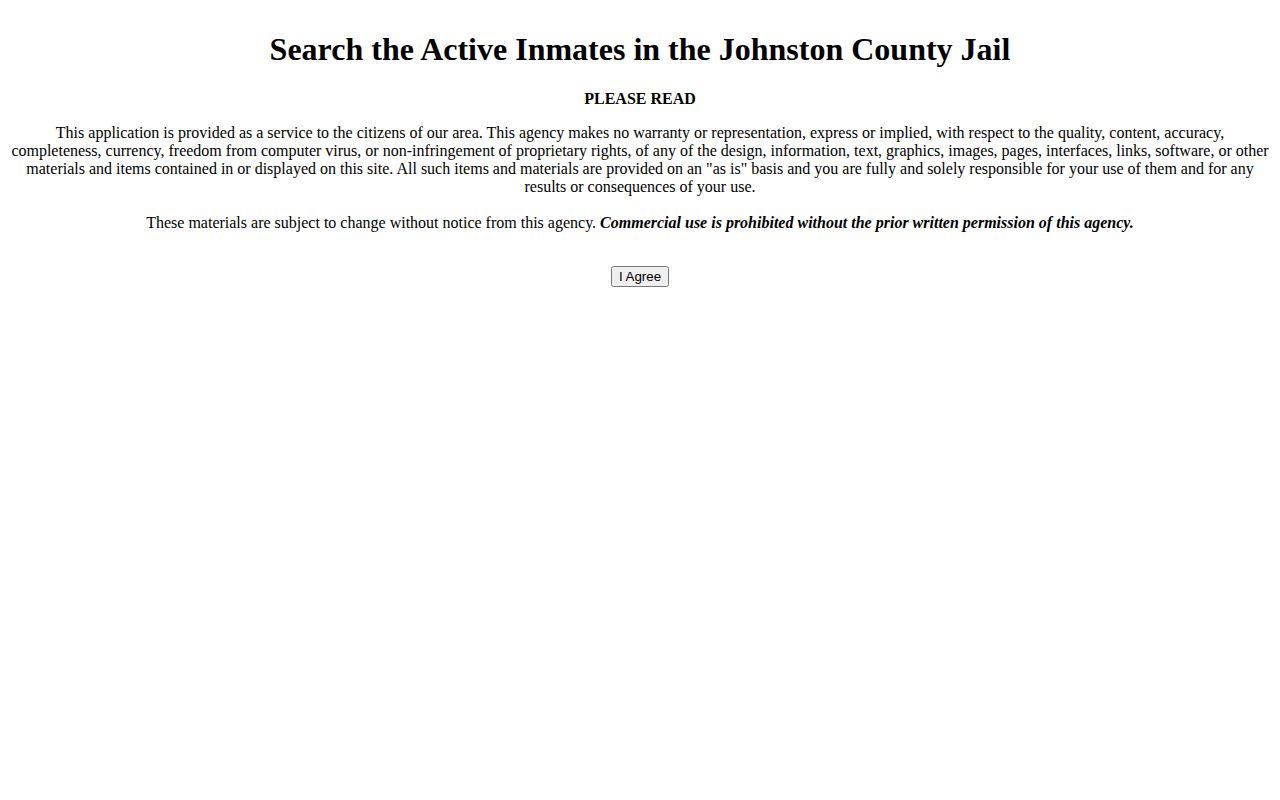
The neutral search view shows where current-custody records begin. It is a roster interface, nothing more. JCSO has published no universal photo-release rule and no stated persistence period for online entries. A person can stay listed on the roster long after the arrest date if they remain held. Someone released may drop off even though the booking record still exists through a records request or the recent-arrest system. Skip any app claiming to show county inmate photos. Use the JCSO website instead.
Busted Last Night in Johnston County
The JCSO recent-arrest form reaches back 15 days. A name search requires the last name, with the first name optional. Date searches take a beginning and ending date in month/day/year format, inside the rolling limit. Results can include full name, age, arrest date, and charge. The detail view may add sex, race, booking agency, bond amount, bond type, and an image when one exists.
There is no separate official 24-hour, 48-hour, 72-hour, or weekly feed. Everything runs through one form. For a same-day view, set both ends of the range to today. For two or three days, widen the range. A week still fits comfortably inside the 15-day maximum. JCSO says arrest information is updated daily, so a very fresh booking might not appear until the next update runs.
Feed-window note: The 15-day window limits online access only; after it closes, request the record from JCSO or the arresting agency and use eCourts for case events.
A quick search can look incomplete for several reasons. Weekend volume piles up. Updates lag. An outside agency handled the booking. The person was already released. Note the displayed data timestamp and the date range you used before assuming anything. Third-party archives do reach beyond 15 days, but copied coverage is not official and can preserve a wrong or outdated charge line.
NC DAC Offender Records
State custody has its own lookup. The North Carolina Department of Adult Correction search covers inmates, probationers, and parolees back to 1972. County jail data is left out. Treat it as a second layer behind the Johnston roster and the 15-day arrest form.
The Offender Public Information locator takes a name or an offender ID. Search tips there mention a seven-digit offender number, docket-number formats, transportation numbers starting with T plus six digits, and SID formats. Those keys belong to the state system. They are not Johnston booking numbers. Public fields can include aliases, conviction offenses, dates, sentence, facility, control status, release details, and detainers.
No county-style mugshot field exists on the DAC locator, so skip the photo expectation. The record shows custody status after sentencing. Probation or parole there is not a fresh Johnston arrest at the county jail.
Booked, Released, or Transferred?
Where a record shows up depends on custody status. One arrest can pass through several systems, and no single one tells the whole story. Treat the table as a routing guide. Then confirm the case with the agency that actually holds the person or the file.
| Custody state | Best starting point | What it can show |
|---|---|---|
| Just booked or recently arrested | JCSO recent-arrest form | Recent name, age, arrest date, charge, and detail fields, with photo or bond fields when available. |
| Still in county custody | JCSO inmate inquiry | Current list, primary charge, arrest date, detail demographics, booking date, and photo when available. |
| Released or bonded out | Recent-arrest record, then JCSO request | The person may drop from the live roster while the recent record or underlying booking file remains. |
| State prison, probation, or parole | NC DAC locator | State-custody or supervision information, not county-jail data and not a guaranteed booking photo. |
| Federal or immigration custody | BOP or ICE locator | Separate federal location information. Neither is a Johnston mugshot roster. |
When a name drops off the roster, custody usually changed. A transfer or a display shift explains it too. The charge itself did not vanish. For that answer, pull the Clerk or eCourts docket and read it there.
After a Johnston County Busted Booking
A few terms sort things out fast. Booking is the intake step at the jail. An arraignment or first appearance is a court hearing where the case and release conditions get addressed. Bond is money or conditions set for release. A disposition is how the court case ends, whether by dismissal, plea, verdict, or continued pendency. The arrest record stops at intake. That's why these words matter.
For court information, North Carolina eCourts is the public tool. The Johnston County Clerk of Superior Court, at 207 E Johnston Street in Smithfield and 919-209-5400, holds the official and certified records. Ask the Clerk about a docket, not the live jail roster. Release-requirement questions go to the Magistrate Office at 919-209-5463, per the JCSO FAQ. Never guess an outcome from a missing roster entry.
A booking photo travels far. News outlets and third-party pages often copy the original charge and picture. That can happen long after the court reduces or dismisses the case. Read the docket and the disposition first. Then decide what to repeat.
Here is a clean way to check. Save the exact name, arrest date, and charge wording from the JCSO detail page. Search eCourts by name or case number, compare the county, and read the docket events. Nothing turning up? Ask the Clerk about spelling, indexing, jurisdiction, or restricted access. The official NC eCourts page is the source for this court-search route.
That court layer is what connects an arrest entry to everything that happens afterward. Use it to follow the case beyond the booking record itself.
Booking Timing and Older Records
Johnston's arrest form runs on a rolling 15-day window. There is no separate "today" page. With a firm date, narrow the form for same-day or two-day checks. Broaden it to three, seven, or fifteen days when unsure. JCSO says the data is updated daily. The live roster has its own job, showing current custody with its own timestamp, so don't treat the two as one archive.
The county moved 283 inmates into a new detention center in 2023. It spans roughly 118,000 square feet. Local coverage of that move explains why older pages still point to a former jail address. It also explains aging service details. The current detention page names PayTel, while older FAQ material names Securus. Check current JCSO contact information before visiting or dialing an old number.
For older bookings, ask JCSO three things: whether the record is still held, whether the photo became part of a case file, and whether another agency now holds it. The State Archives schedule is a guide, not an online archive. It allows possible in-office destruction after three years for identification photos that never entered a case file, while case-file photos follow different schedules. No digitized Johnston mugshot collection turned up. The Heritage Center and Archives may hold historical material, but neither is a public photo gallery.
Busted Mugshots by Johnston City
City police and county detention split the work. An officer in Clayton, Smithfield, or Selma makes the arrest. He writes an incident report for that city. Once the person enters county custody, things shift. The Johnston County Detention Center then creates the booking record, and the county tools become the main public search path. None of the three city police sites keeps a routine public daily mugshot blotter, so the county path is usually the one that pays off.
- Clayton Busted Mugshots covers the Clayton Police report path, county booking route, and local coverage.
- Smithfield Busted Mugshots explains the county-seat records split between police, JCSO, and the Clerk.
- Selma Busted Mugshots covers the Selma records contact, county booking route, and regional news context.
The map draws on 2020 Census counts. It covers Clayton, Smithfield, and Selma. A city label in a news story doesn't prove a city police booking, and a county booking doesn't settle the court question either. So treat three facts as separate. Check the arresting agency. Check the booking destination. Then check the final outcome on its own.